On the underside of the base plate there should be flat blade set screws that affect the secondary opening amount. You can replace the screws with allen head set screws to allow adjustment from the top. T-slots square means they look like little squares at idle, as much exposed as they are wide. You can cheat the secondaries a little to allow the primaries to be closed more, the t-slot position has more of an impact on the primary side. If it reaches the point where they can't be closed enough, usually on an engine with a healthy cam, as long as timing is maximized you would need to add small holes in the butterflies to allow more air in at idle to allow the blades to be closed sufficiently at idle. Too much exposure will start drawing fuel at idle from the transition slots, and at some point will render the mixture screws useless. One thing that my help close them is initial timing, have you experimented with using more? I understand not wanting cranking issues, but if it will stand more initial it will have more idle vacuum and allow a smaller throttle opening, closing the primary blades and exposing less t-slot. Easy enough to bump up the timing to check idle to around 2000 RPM operation, once you find the most it will stand you can set the distributor curve to limit total timing to what the engine needs.
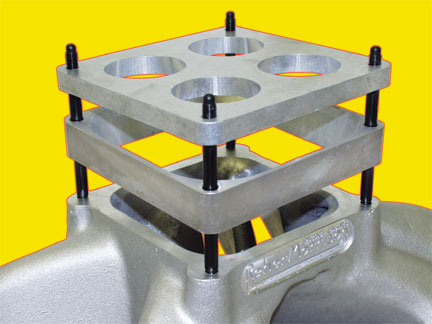
As far as spacers, they are usually a bandaid for some other issue. Intake plenum size too small or large, too much reversion from the cam or intake runner length incorrect. With that said, a lot of engines can improve from a spacer of some sort, unfortunately it a trial and error thing. If you have none to borrow and want to purchase something, I would suggest something like the anti-reversionary spacer below sold by Reher-Morrison. If it wants any at all it will probably gain with that one, and less likely to lose any. Available for 4150 or 4500 carbs. And if it does help, remember you are affecting the signal at the carb and may need a jet change.